Saturday, October 6, 2012

"You can't be what you can't see" -Mirian Wright Edelman


      For decades for centuries Since the beginning of time, women have been prisoners of war, held captive and tortured, stripped of their self worth and robbed form their ownership of their true identities. Bell Hooks describes something similar to this in The Oppositional Gaze, when she describes how slave owners deprived their slaves from using their own gaze. As such, advertisers have blinded women from having their own "gaze" or reflection of themselves, so bad that it does not exist anymore; for their reflection now represents a males perception. And what exactly is the male perception? Berger explains the male perception of a woman as merely an object; an object of desire or sexual pleasure. Women have been painted by advertisers to portray not only objects of sexual desire, but also as maids. A woman's sole responsibility is to look beautiful and serve her man. It has been a vicious cycle; where advertisers not only try to sell their products but they have implanted objective meanings to what it is to be a woman. And the cycle will keep spinning so long as women accept it.


       We have been brainwashed so much that we have lost our identities. Although there seems to be no cure for this, i believe that the cure can be found within the disease. The same way ads took us from Rosie the Riveter, during WWII to house wife bare foot and pregnant after the war, to pretty house wife, bare foot and pregnant, to the now; beautiful sexual perfect beings for men; we have the same power to shut them down using anti advertising ads as well as educating young girls and boys. Alternative media has already been launching its war against racist and sexist ads. A perfect example of this is misrepresentation.org. A web site designed to educate girls and boys of all ages on sexism in advertising. The have also created a short film as well as a curriculum and a blog. Their mission is to "shift peoples consciousness, inspire individual and community action, intimately transform culture so everyone, regardless of gender, can fulfill their potential." This campaign is drawing much attention, not only to the general population but to celebrities, which i think is a key aspect to change. Creating awareness is the most valuable concept of change. Katie Couric said "The media can be used as an instrument of change: it can maintain the status quo and reflect the views of the society or it can hopefully, awaken people and change minds. I think it depends on who's the piloting the plane."

     Somewhere somehow, feminism lost its fuel. Sadly, advertisers did it again, representing feminist as cruel, angry, man hating lesbians; which is obviously NOT true. Women are now afraid of calling themselves feminist and for this reason, the fight is a fight which lost its soul. Every woman should be a feminist, why not? Are they afraid that men see them in a light that they do not want them too?? (sarcasm) It is shocking as to why women put up with this, some argue that women must like being treated as such, because they still buy the products and still try to mimic that unrealistic body frame and have no qualms with it. However, It is documented throughout history a how the ideology of one man can start a revolution and blindside an entire nation; Hitler and slavery itself are great examples of this. However, no one really has been paying too much attention to women and their over sexualized imagery.

      We must realise who has the power and who is at the top of this hierarchy. Is it really the top advertising executives? Or is it the consumers? The advertising companies need us to need them and their products, however they are not forcing us to do so. We need to advertise against advertising and if & when we hit a wall, break through it and keep going. We [women] are the puppeteers and they are the puppets. They want our money but we do not have to give it to them, we do not have to buy their make up, their clothes, watch their commercials, etc. We have the buying power. We no longer have to accept or expect the unacceptable. Now with social media surrounding our daily lives, we see a lot more of celebrities and models in the raw, which is often not very flattering. Although some may say this is a positive movement which will relieve pressures from women trying to "perfect" themselves, I will argue that this may be a hinder to women in progressing away from sexist consumerism. Women have the anxiety of having to look a certain way every minute of the day and force them into buying more products.
    The way men and women are starting to view sexism and sexist ads is slowly shifting into a new direction. People are becoming aware and women are angry once again. Movement is starting to take place. Advertisers are getting informed and in the past have tried to make women feel better by over sexualising men. Making them appear in ads showing their bodies. However, it's only making men more stronger and muscular yet women appear thinner and weaker, so the male still dominates. This is not the answer. We need to continue to educate and create educational classes, such as women and gender studies, mandatory. We must continue to push campaigns such as the one Miss Representation is pushing. As the CEO of Paley Center for Media said "We have enormous power. Eighty-six percent of the purchasing power in this country is in the pockets of women. Well, let's us it."

Alternatives to Advertising

What happened to the mode of persuasion being to sell a product based on its features and benefits? Instead today we sell our products by making the consumer feel inferior, inadequate, and ill-favored. Today the goal of advertising is to make the consumer feel the "need" to buy a product, and their strategies include giving reason to "fix" a flaw or "fill" a hole.

According to Cosntructed Bodies, Deconstructing Ads: Sexism in Advertising, "To be successful, an ad must be persuasive on two levels. First it should persuade you that you need something... Second, an ad must provide the solution" (p.63). This is usually the case with cosmetics. When selling eye shadow, lipstick, mascara, etc, gorgeous models are shown flaunting the product. Their lack of imperfections make you doubt your own beauty and therefore, increase your desire to own the product. We equate their product with perfection. Most of the money spent on cosmetics are not even used to make the product, "only 8 cents of the cosmetics sales dollar goes to pay for ingredients; the rest goes to packaging, promotion, and marketing" (Cortese p.55). In other words, most of the revenue is used on perfecting the model in order to make the consumer feel worthless.

Besides introducing gorgeous models, the advertising industry also loves to use bodies to sell products. Their favorite? Female bodies. In Sex, Lies, and Advertising, Gloria Steinem explains carmakers were using blondes to decorate their car ads by "draping [them] over the hoods like ornaments" (p. 113). This following video does not necessarily "drape" the woman on the car, but even worse, portrays the woman to be the car itself.


In Costructed Bodies, Deconstructing Ads: Sexism in Advertising, there is a quote by John Berger:

"The promise of the commercial is not just 'You will have pleasure if you buy our product,' but also (and perhaps more important), 'You will be happy because people with envy you if you have this product.' The spectator of the commercial imagines herself transformed by the product into an object of envy for others - an envy which will justify her loving herself. The commercial images steals her love of herself as she is, and offers it back to her for the price of the product" (p. 62).

Berger is only speaking of women with his claim, however this can apply to men as well. The following image is practically telling men "if you buy this car, women will be all over you, and because of this men will want to be you."


Look at these example of sexist ads:


"Give and you shall recieve" ?!! What is this teaching little girls? You must give your body to get what you want from a guy OR if a guy gives you something nice, you must give your body in return. No, no, no, no, no.. 


Who says women don't like action films? Who says women will not drink anything with 10+ calories? Who says we only watch romantic comedies and drink "lady drinks?" ...whatever that means.

Look at this example of a racist ad:


Okay, Intel. I see what you are doing here. Placing runners to prove you have fast speed. But why is there a guy standing in the middle, while these other guys are bowing down. Why is he white, and them colored? Hmm..

The media needs to stop circulating sexist and racist ads. They need to stop using beauty and bodies to sell their products. Words of the wise: 


I believe the best way to do this would be TO STOP PHOTOSHOPPING! As Kilbourne once said, these ads are made to perfection, the models do not even have pores! Everyone is aware bodies come in all different sizes: thin, thick, big, small, tall, and short. They also come in different colors, but one thing we all have in common are PORES! Yet the models in these ads seem to not have anything in common with us. Constructed Bodies, Deconstructing Ads: Sexism in Advertising states advertising produces representations of a "mythical, WASP-oriented world in which no one is ever ugly, overweight, poor, toiling, or physically or mentally disabled" (p. 52). Advertisements need to start having "real people" sell their product. Something Dove's Real Beauty Campaign was aiming at:


These ads show REAL WOMEN. Women of different colors, ages, and body types. We need women like this in all of our advertisements. 

Another type of advertisement that can work as alternative to the already sexist, degrading, "make you feel worthless," types of ads is subvertisement. "Subvertising used the power of brand recognition and brand hegemony either against itself or to promote an unrelated value or idea" (p. 49), it plays with slogans and logos to advertise something else, sometimes the complete opposite of what the original ad was selling. Figure 3.7 in Constructed Bodies, Deconstructing Ads: Sexism in Advertising shows a model walking down the run way holding a fur coat drenched in blood. This ad is pro-animal rights. Figure 3.15, in the same reading, shows an ad that reads "Hey Bud, Quit Using Our Cans to Sell Yours" with three serious women on the side. This ad is obviously for Budlight, a beer company, that normally uses women's bodies to sell their product. 

Other examples of subvertisements include: 


If advertisements begin to turn it down on a notch on perfection, maybe we could begin to solve one of America's greatest problems. Sell us your products in an honest way - for its benefits and features. Don't give us a "need" for it, give us a reason to actually want it.


Gender and Advertising


It is common practice to use sexism in advertising.  This tried and proven method of objectifying women successfully garners sales for companies wishing to increase profits.  Although this method is successful, the ramifications of such shrewd advertising have long-reaching negative effects on women and society.  Therefore, it is imperative to find an alternative method of advertising. Not only is it morally sound, it is also financially sound to use a different advertising strategy.  For example, Dove’s Campaign for “Real Beauty” has successfully increased their sales through advertising women of various age, shapes, sizes, and ethnicity.  Therefore, alternative advertising strategies are just as successful, if not more so than the traditional sexist advertising strategy.  Such alternative advertising strategies and goals includes the promotion of health and longevity.

            Going against the mainstream images of beauty is certainly what Dove’s Campaign for “Real Beauty” has done.  Why is it different?  Dove advertised using women of various age, shapes, sizes, and ethnicity.  These women are not the “idealized” appearance typically seen in the media. Rather, these women are of various age, shapes, sizes, and ethnicity.  Through these women, the campaign promotes a redefining of “real beauty” being that of all age, shapes, sizes, and ethnicity.  With this alternative advertising strategy, Dove has increased their sales in Europe and the United States by 700 percent in the first six months.[1]  At the end of the first year of this campaign, Dove’s global sales have reached over $1 billion, which returned $3 for every $1 spent in the campaign.[2]  With this achievement, the campaign was awarded a Grand EFFIE in 2006, which honors the most effective initiative in marketing communications.[3]  Therefore, it is possible to use alternative advertising strategies to effectively garner more profits than the traditional advertising strategy.

            With the success of Dove’s alternative advertising strategy, more companies should employ this positive advertising strategy.  Morally, companies should use this advertising strategy to begin with because advertising sells much more than a company’s products.  According to Kilbourne’s “Beauty and the Beast of Advertising,” advertising also sell values and concepts of success, worth, love, sexuality, popularity, and normalcy.  With such a powerful tool to skew public perspective and affect the lives of many individuals, morally, companies should use advertising in a responsible manner.  However, most companies fail to uphold any standard of morality when it comes to advertising.  According to Wolf’s “Culture from The Beauty Myth”, companies and advertisers discover that people will buy more things if they are kept in the “self-hating, ever-failing, hungry, and sexually insecure state of being aspiring “beauties”.”  This is achieved by advertisers defining the “ultimate image,” which is naturally unattainable.  Therefore, the “ideal image” can only be obtained through the purchase of vast quantities of products.[4]  Although this advertising strategy is successful in increasing company’s sales, it promotes an unhealthy self criticism, which is harmful to consumers and companies in the long run.  As a result, companies’ target audience is more likely to develop depression and eating disorders, such as anorexia and bulimia.  Therefore, in the long run companies would have trouble sustaining their sales because their customer base has a shorter life expectancy and disappearing quicker.  More effort would then have to be made get more people to buy their products.
            An alternative advertising strategy that promotes health and longevity will prove more successful than the traditional advertising strategy.  With an emphasis on health, a company’s target audience would be swayed to live a healthy life style.  Therefore, the company’s target audience will have a longer life expectancy.  As a result, the company’s target audience will have more opportunity to purchase their product.  With promoting such a positive healthy image, people’s trust in the company would increase.  As a result, people would be more likely to purchase related products the company offers.  Having a positive image for the company would also help lower cost of advertising because consumers would engage in word-of-mouth advertising.  For example, Dove’s Campaign for “Real Beauty” received free advertising from media coverage on television show, such as The Oprah Winfrey Show, The Ellen DeGeneres Show, The Today Show, The View, and CNN.[5]  Therefore, with positive advertising strategies and goals, a company would be more successful in the long run.
            Advertising with the traditional strategies of promoting negative self criticism might be effective but it is not the only effective advertising strategy.  Examples such as Dove’s Campaign for “Real Beauty” have shown that alternative positive advertising strategies are just as successful, if not more so than the mainstream advertising strategy.  With the promotion of health and longevity, a company’s customer base is more likely to live longer.  Therefore, the repurchasing power of their customer base would be stronger.  Sales would continue with less advertising dollars required due to word-of-mouth advertising.  Customer loyal and trust would also develop using this positive advertising strategy.  The company would also create for itself a positive image, thus, making the company more valuable.  Therefore, more companies should discard the traditional advertising strategy and start employing the alternative positive advertising strategy.
           

Works Cited

Cortese, Anthony.  “Constructed Bodies, Deconstructing Ads: Sexism in Advertising.” Provocateur: Images of Women and Minority in Advertising.  United States: Rowman & Littlefield Publishers, Inc, 2008: 45-76.

Falcione, Olivia and Laura Henderson. “The Dove Campaign for Real Beauty: Case Study.” Public Relations Problems and Cases. March 1, 2009. <http://psucomm473.blogspot.com/2009/03/dove-campaign-for-real-beauty.html>

Kilbourne, Jean.  “Beauty and the Beast of Advertising.” Media&Values.  United States: Center for Media and Values, 1989.

Wolf, Naomi.  “Culture.” The Beauty Myth: How Images of Beauty are Used Against Women.  United States: Morrow, 1991: 58-85.


[1] Falcione, Olivia and Laura Henderson. “The Dove Campaign for Real Beauty: Case Study.”
[2] Falcione, Olivia and Laura Henderson. “The Dove Campaign for Real Beauty: Case Study.”
[3] Falcione, Olivia and Laura Henderson. “The Dove Campaign for Real Beauty: Case Study.”
[4] Cortese, Anthony.  “Constructed Bodies, Deconstructing Ads: Sexism in Advertising.”
[5] Falcione, Olivia and Laura Henderson. “The Dove Campaign for Real Beauty: Case Study.”

The enemy that dreams are made of?

Advertising does not have to be the enemy! The public as a whole have always been so complacent and willing to let others dictate how they should feel, what they should want, what they should look like and have gone as far as to tell us what our days look like and even further still some have even brought forth higher rates of lung cancer and alcoholism. 

"The ads sell a great deal more than products.  They sell values, images, and concepts of success and worth, love and sexuality, popularity and normalcy.  They tell us who we are and who we should be.  Sometimes they sell addictions." (Kilbourne 121)


The problem is that advertising agents, the ones creating these ads are there to do a job and that job is to make the company they are working for as much money as they can.  Their job is not to have a conscience!  If every ad executive had one of those maybe just maybe women would not always be worrying about such petty things as their weight, and their house chores; maybe men would not see women as objects and as human beings that have a voice; maybe not as many people would be dying from lung cancer and speaking of lung cancer tabacco companies were actually willing to expand their ads to women consumers, sure lets kill women too by making cigerettes look beautiful! Readers of Ms. magazine were enraged to say the least.  The asked: "would you show a vlack man picking cotton, the same man in a Cardin suit, and symbolize the antislavery and civil rights movements by smoking (Steinman 116)?" Needless to say Philip Morris pulls their ads from Ms. magazine.

So now we are not out in the fresh air doing house chores but out in the cold destroying our lungs!
Ms. Had a great concept when they started their publication, however their magazine unfortunately did not succeed, maybe because they needed to make it more "user friendly" and by that I mean they needed to find a way to be able to promote to men too.  The ad executives for instance of the car industry in Detroit were men and men did not and still do not quite understand women issues.  Why can't a car manufacturer advertise to women?  "Detroit never quite learned the secret of creating intelligent ads that exclude no one" (Steinman 114).  Cars are not a gendered product, why couldn't they understand that the focal point should be the car itself and the features it offers?  These type of specifics do not speak more to man or woman they simply speak to a consumer in need of an automobile.
Pink trains were a complete failure
girls like trains too and do not need pink ones
Advertising executives like Lionel a toy train company were concerned with trying to market their products to girls and saw their chance with Ms. magazine.  "They made a pink train, and were surprised when it didn't sell.  Lionel bows to consumer pressure with a photograph of a boy and a girl- but only on some of their boxes.  They fear that, if trains are associated with girls, they will be devalued in the mids of boys" (Steinman 115)


America was founded on the belief of freedom, but freedom for whom?  Specific groups have been descriminated against for ages.  Of these groups some continue to be.  However, groups that werent descriminated against earlier are now starting to be.  Is this the answer?  My answer is No!  it perpetuates a visious cycle, one in which no one will ever be happy with who they are, what they have and what they are living for.


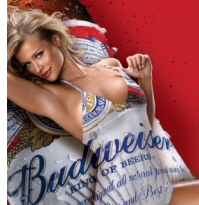
Beer ad's have become quite rediculous, using women as bottles, displaying naked women holding beer or painted with the logo.  Why not use an average woman in normal attire to sell beer?  Wouldn't this cater to more women then the skinny, perfectly curved woman dressed as a beer bottle?  Because how many women in the world truly look like that?  How many in the world are truly not offended by that.


Advertising executives would do better to have a conscience.  Companies would do better if they had one too.  Why not listen to the public?  Why not listen to statistics?  "Objectified constantly by others, she learns to objectify herself.  One in five college-age women have an eating disorder" (Kilbourne 123-124). 

The average female body comes in a variety of shapes and sizes from underweight to a few pounds over weight
These women are all beautiful, however ad executives, fashion designers and just humans in general would beg to differ, finding flaws in each and every one of them because for hundreds of years we have been told how to think and feel.  I will hand it to advertisers, they sure do know how to brain wash us.  Advertising agents create ads that "generate dissatisfaction and by offering images of transformation, of a 'new you'" (Kellner 130).  But here is the thing, why can't they brain wash us again so that we can accept who we are. Brain wash us again so that unhealthiness is not what we strive for.  Include minority groups because those minority groups such as African Americans, Hispanics and the LGBT have a large spending power that has yet to be tapped into.  We need to do this right.  We need to attempt to fix the world's view of people in generel and especially of
themselves.


Works Cited:

Kilbourne, Jean. “Beauty and the Beast of Advertising." Gender, Race and Class in Media. Ed. Gail Dines, Jean M. Humez. Thousand Oaks: Sage Publications, Inc, 2003.

 
Steinem, Gloria. “Sex, Lies and Advertising.” Gender, Race and Class in Media. Ed. Gail Dines, Jean M. Humez. Thousand Oaks: Sage Publications, Inc, 2003.

 
Kellner, Douglas. “Reading Images Critically Toward a Postmodern Pedagogy.” Gender, Race and Class in Media. Ed. Gail Dines, Jean M. Humez. Thousand Oaks: Sage Publications, Inc, 2003.
 
Images Cited: